Mastering Forex Risk Management

However, price movements can quickly turn against a position and that is why risk management is crucial in forex trading.
Forex risk management is the process of controlling potential losses while trading foreign currency pairs. It includes setting position sizes, managing leverage, using stop-loss orders, analyzing exchange rates and defining how much capital to risk on each trade.
No forex strategy guarantees profits. Effective risk management instead focuses on controlling exposure so that individual losses do not significantly damage a trading account. This guide explains the core principles, tools, and practical approaches forex traders can use to manage forex risk.
Key Takeaways
- Effective forex risk management helps traders control potential losses through position sizing, stop-loss orders, and defined risk limits.
- A consistent risk management plan combines technical tools, diversification, disciplined trading rules, and regular performance reviews to manage exposure over time.
Core Principles of Foreign Exchange Risk Management
Managing risks effectively is the foundation of successful forex trading. It ensures that traders can endure the ups and downs of market movements without blowing their capital. By sticking to the following principles, traders can safeguard their investments, optimize returns, and maintain consistency in a volatile environment.
Leverage Management
Leverage amplifies both potential profits and risks, making its management essential for sustainable trading. Over-leveraging, using excessive borrowed funds, can lead to significant losses, even with small market movements.
For example, a trader with $1,000 using 1:100 leverage can control a $100,000 position. This can increase profits, but it can also make losses much bigger. Using lower leverage, such as 1:10 or 1:20, can help reduce this risk.
Position Sizing
Position sizing involves determining how much capital to allocate to a trade based on risk tolerance and strategy. It is influenced by factors like account balance, risk percentage, and the distance between the entry and stop-loss levels.
For a $10,000 account risking 0.5% ($50) per trade on GBP/USD with a 50-pip stop-loss ($10 per pip), your position size is 0.1 lots.
Formula:
Position Size (lots) = Risk Amount / (Pip Value × Stop Loss in pips)
Position Size (lots) = 50/(10 × 50) = 0.1 lots
This means you would trade 0.1 standard lots to maintain your risk at $50.
Stop Loss Orders
Stop loss has a significant impact on trading, as it is designed to limit losses and preserve capital. It is a predefined exit point that automatically closes a trade when the market reaches a specified price level.
This helps traders identify the maximum loss per trade, maintain discipline, stick to their risk management plans, and avoid emotional decision-making. Even in volatile market conditions, such as news events that lead to significant market moves, the stop-loss is the safest tool to protect against potential risks.
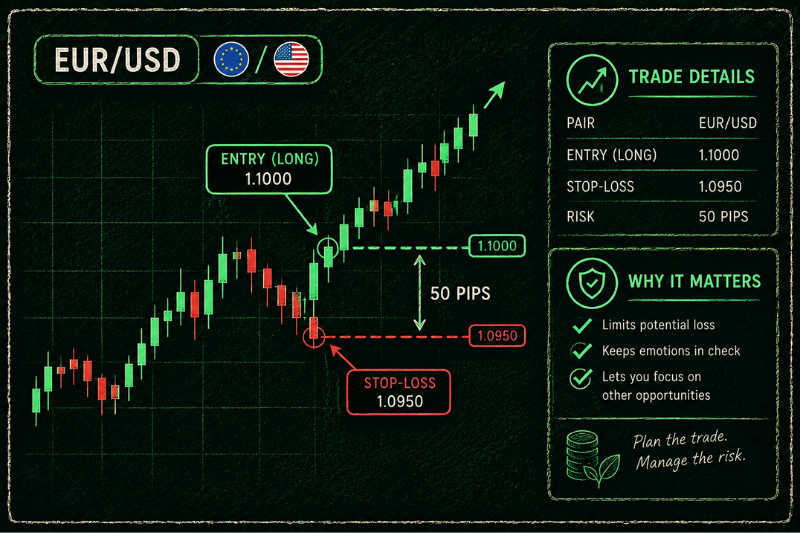
For example, a trader entering a long position on EUR/USD at 1.1000 might set a stop-loss at 1.0950, risking 50 pips. This caps the loss if the trade moves against them, allowing the trader to focus on other opportunities without emotional interference.
Take profit orders
A take profit order is a predefined instruction to automatically close a trade once it reaches a specified profit level. It allows traders to lock in gains without actively monitoring the market, ensuring their targets are met as planned. This tool is essential for trading, helping traders avoid watching price movements all the time.
Suppose, a trader buys GBP/USD at 1.2500 with 0.5 lots ($5 per pip). Setting a take-profit at 1.2550 (a 50-pip target) secures a $250 profit once triggered.
Formula:
Total Profit=Target (pips)×Pip Value = 50×$5=$250
Risk-Reward Ratio
The risk-reward ratio is an important concept in trading that helps traders define the potential profit versus potential loss of a trade. A balanced ratio, such as 1:3 or 1:4, ensures that the rewards outweigh the risks over time, even if some trades result in losses.
To calculate the risk-reward ratio, traders compare the distance between their entry point and their stop-loss level (risk) to the distance between their entry point and their take-profit level (reward).
For example, if a trader risks $100 to potentially gain $400, the risk-reward ratio is 1:4. This means that even after losing four trades in a row, the trader can recover all losses with just one winning trade.
By consistently applying a favorable risk-reward ratio, such as 1:4, traders ensure that their potential reward justifies the risk taken. This approach helps minimize losses and maximize overall profitability.
Developing a Risk Management Plan

A robust risk management plan begins with setting clear risk parameters. Decide the maximum percentage of your account you're willing to risk per trade. Similarly, set a daily risk limit to avoid significant losses in a single day, helping you maintain control even during volatile periods.
Next, identify your trading goals and align them with your risk tolerance. Your risk tolerance depends on your capital size, trading style, and emotional resilience. Clear goals ensure your approach is consistent and manageable.
Adaptability is also crucial. Create rules for adjusting risk in different market conditions. During highly volatile markets, reduce your position size to minimize exposure, while in stable conditions, consider slightly higher risks within your set parameters. This flexibility ensures that your plan works in various scenarios without jeopardizing your account.
Difference between a standard account (broker) and a funded account (prop firm) in terms of managing risks
In a standard trading account, brokers impose no restrictions on risk. You can risk as much as you like per trade or day, which often leads to overleveraging and account wipeouts. This lack of limitations can be destructive, especially for beginners who struggle with discipline.
On the other hand, prop firms provide you with trading capital and impose risk limits, such as a 5% daily drawdown and a 10% overall drawdown. While these restrictions might seem limiting, they are designed to protect you and make you a disciplined trader. Sticking to such rules can help you build a consistent risk management plan and, ultimately, achieve long-term profitability.
Example of an Effective Risk Management Plan for a Prop Firm Account
Imagine you're a day trader managing a prop firm account with a 5% daily drawdown limit and a 10% overall drawdown. Here is a plan you can set:
- Always use a stop-loss to control risk on every trade.
- Limit daily losses to 2% and stop trading for the day if reached.
- Risk 0.25%-0.5% per trade, depending on trade quality; higher confidence trades can justify 0.5%.
- Stop trading after 4 consecutive losses and return the next day.
- Use a reasonable risk-to-reward ratio, like 1:3 or 1:4, aligned with your strategy.
- Diversify capital across markets but avoid excessive risk in highly volatile markets.
- Journal every trade, noting entries, exits, and outcomes. This helps you identify weaknesses, mistakes, and areas for improvement, allowing you to refine your strategy and ultimately become a better trader.
Ultimately, risk management strategies are about discipline, sticking to your predefined rules, avoiding impulsive decisions, and continuously reviewing your plan as your trading experience grows. With this foundation, you can protect your capital and build a successful trading career.
Essential Tools and Approaches for Managing Risk
Managing risk in forex trading requires a combination of technical tools, risk diversification, and emotional discipline. Together, these elements safeguard capital and improve trading performance.
Technical Tools
Tools like Position Size Calculators, stop-loss orders, take profits, and trailing stops allow traders to manage their positions systematically. Platforms such as MetaTrader, cTrader, and Trade Locker offer advanced features, including margin calculators and real-time alerts, to monitor risk exposure.
Risk calculators also help determine the correct position size based on account size and the desired risk percentage. These tools ensure trades are managed consistently without emotional interference.
Risk Diversification
Diversification spreads risk across multiple trades, currency pairs, or strategies to reduce exposure to any single risk. Combining different pairs and strategies, like swing trading and scalping, helps adapt to market changes and minimizes risk exposure.
Emotional Tools
Emotions like fear and greed often lead to impulsive decisions and increased risk exposure, so developing a disciplined trading psychology is important. Setting predefined rules for entries, exits, and risk limits removes the need for impulsive decisions and lowers emotional stress. Techniques like journaling and backtesting help traders reflect on their performance and maintain focus under pressure, ensuring emotional control and better decision-making.
Creating a clear trading strategy is also essential. When you build a strategy with an edge, backtest it, and combine it with a solid risk management plan, you can enter trades with confidence and without fear.
Trusting your strategy and knowing its win rate allows you to handle losses better, understanding that consecutive losing trades are part of the process. By sticking to your plan, you improve over time, knowing that after losses, wins are likely to follow.
Common Mistakes to Avoid
This is a list of the most common mistakes you should avoid as a trader:
- Overleveraging: Using excessive leverage increases potential losses. Always use leverage within your risk tolerance.
- Ignoring Stop-Loss Orders: Not setting stop-loss orders can lead to larger-than-expected losses.
- Risking Too Much Per Trade: Risking a large percentage of your capital per trade can quickly deplete your account. Stick to a small percentage.
- Lack of Diversification: Relying on the same currency pair or strategy exposes you to higher risk. Diversify to reduce risk.
- Emotional Trading: Letting fear, greed, or impulsiveness guide decisions can result in mistakes and eventually cause you to lose money.
- Neglecting trading strategy: Trading without a clear strategy and risk management plan can lead to inconsistency and losses.
- Overtrading: Trading too frequently or taking unnecessary risks can result in burnout and losses. Stick to your trading strategy and avoid overtrading.
- Revenge Trading: Trying to make up for a loss by taking impulsive, high-risk trades can result in even greater potential losses. Stay disciplined and stick to your plan.
- Chasing the Market: Entering low-quality trades out of fear of missing out, rather than focusing on high-quality setups, can lead to major losses.
- Ignoring Risk-Reward Ratios: Not maintaining a good risk-reward ratio can lead to unbalanced trades, increasing the likelihood of losses.
Avoiding these common mistakes can help improve consistency and protect your capital.
How Top One Trader Empowers Traders to Manage Risks

Top One Trader offers extensive educational support, including weekly coaching sessions, video lessons, and resources focusing on risk management and mindset development. Traders also gain access to a community of experienced peers to share insights, strategies, and feedback, fostering growth and confidence while maintaining alignment with effective risk management practices.
Key tools and resources include:
- Advanced Trading Platforms: Access to cTrader, MetaTrader, and Trade Locker integrated with TradingView for precise market analysis, strategy execution, and application of risk management rules.
- Dashboard: Displays critical metrics like balance, profit/loss, daily drawdown, overall drawdown, trading days, average risk-to-reward ratio, win rate, and profit targets.
Top One Trader also offers up to 90% and 100% profit margins on specific accounts and flexible evaluation programs, including one-step, two-step, and instant funding challenges. These options enable traders to choose their strategy and select the risk management plan that fits their approach to trading, and progress at their own pace to showcase their skills effectively.
Conclusion
Managing risk is an important factor in forex trading success, helping traders navigate market volatility and preserve capital. By integrating risk management strategies into your trading plan, you build a foundation for consistency and long-term profitability.
Start your journey in forex trading today, partner with Top One Trader, and take control of your financial future!
Frequently Asked Questions
How do you manage risk in forex trading?
Manage forex risk by limiting how much you risk on each trade, using stop-loss orders, controlling leverage, choosing the right position size, and setting clear daily and overall loss limits. A consistent risk management plan also includes a defined risk-reward ratio, diversification, and regular trade reviews.
What is the 2% rule in forex trading?
The 2% rule means risking no more than 2% of your account balance on a single trade. However, many traders use much lower risk levels. For prop firm accounts, risking around 0.25% to 0.5% per trade can give you more room to stay within daily and overall drawdown limits.
How does slippage affect forex risk management?
Slippage can cause a trade to close at a different price than expected, making the actual loss larger or smaller than the planned risk.
What is a margin call in forex trading?
A margin call occurs when a trader's available account equity falls too low to maintain their open positions under the broker's margin requirements.
How should traders manage risk when holding multiple open trades?
Traders should consider the combined exposure of all open positions rather than evaluating each trade's risk separately.
Can forex risk management eliminate trading losses?
No. Risk management cannot prevent every loss, but it can limit the impact of individual trades and help protect trading capital.
What is the difference between a drawdown and a trading loss?
A trading loss refers to an individual losing trade, while drawdown measures the decline in an account from a previous peak to a later low.